Yoshio Otomo, Alto Sax
B-side
/
Yoshio Otomo emerged from Tokyo’s jazz scene in the early 1970s after moving from clarinet to alto saxophone while studying at Nihon University. He worked with Fumio Itabashi, Takashi Mizuhashi and other musicians around the emerging Japanese modern-jazz scene, and by the middle of the decade had begun recording under his own name. Moon Ray, released in 1977, was his second album as a leader.
Otomo’s playing is expressive without becoming excessive. His alto has an edge, but the phrasing remains strongly melodic — closer to a vocal line than to the more abrasive language developing elsewhere in Japanese jazz at the time. That balance between warmth and attack is especially clear on Moon Ray.
ALTO / ONE-HORN QUARTET
For Moon Ray, Otomo deliberately chose Tsuyoshi Yamamoto, bassist Tamio Kawabata and drummer O-Jess Kurata— musicians he described as people he particularly enjoyed playing with. The stripped-down quartet leaves the alto completely exposed, while Yamamoto’s piano gives the session much of its rhythmic character.
The repertoire is mostly standards, with Otomo’s own Love Comes Quietly as the only original composition. Rather than relying on unusual instrumentation or electric textures, the record works through interaction: alto saxophone against piano, supported by a compact rhythm section and the very immediate Three Blind Mice recording sound.
SELECTED RECORDS
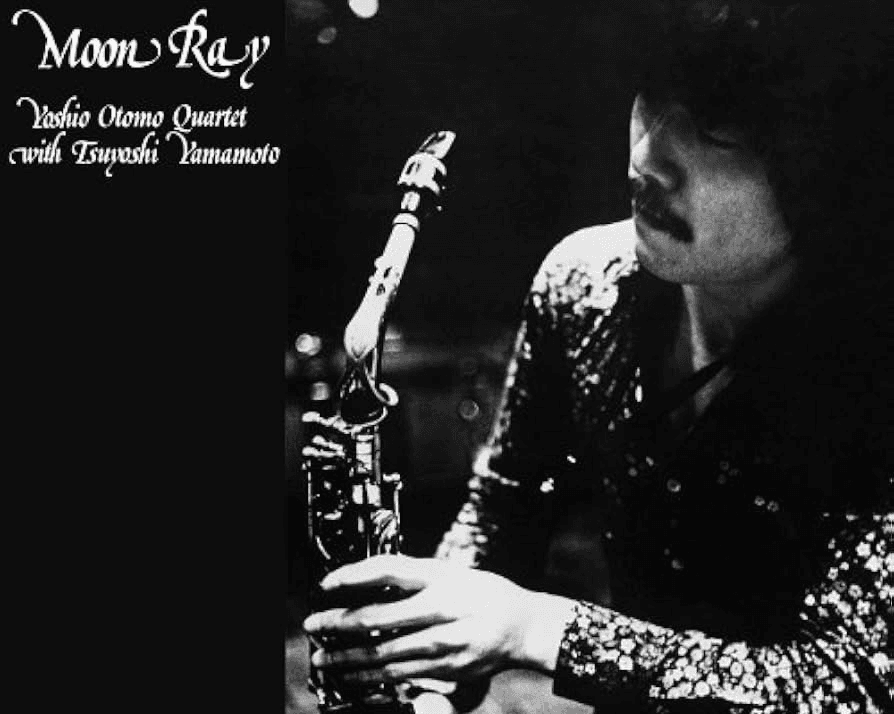
Moon Ray — 1977
Moon Ray is a remarkably direct record. Otomo’s alto stays lyrical even when his tone becomes harder, while Yamamoto’s piano continually pushes underneath him with blues-inflected chords and rhythmic accents. The quartet never sounds crowded; every instrument has enough room to retain its own weight.
For me, the title track captures the album best. It combines a slightly dark, bluesy theme with Otomo’s warm alto and Yamamoto’s forceful piano, establishing immediately the balance between melody and swing that runs through the session.
LISTEN / MOON RAY
Yoshio Otomo — alto saxophone
Tsuyoshi Yamamoto — piano
Tamio Kawabata — bass
O-Jess Kurata — drums
Produced by: Takeshi Fujii
Engineer: Yoshihiko Kannari
Recorded: 21–22 April 1977
Location: Epicurus Studio, Shibuya, Tokyo
Original issue: Three Blind Mice, TBM-3007, 1977
Yoshio Otomo emerged from Tokyo’s jazz scene in the early 1970s after moving from clarinet to alto saxophone while studying at Nihon University. He worked with Fumio Itabashi, Takashi Mizuhashi and other musicians around the emerging Japanese modern-jazz scene, and by the middle of the decade had begun recording under his own name. Moon Ray, released in 1977, was his second album as a leader.
Otomo’s playing is expressive without becoming excessive. His alto has an edge, but the phrasing remains strongly melodic — closer to a vocal line than to the more abrasive language developing elsewhere in Japanese jazz at the time. That balance between warmth and attack is especially clear on Moon Ray.
ALTO / ONE-HORN QUARTET
For Moon Ray, Otomo deliberately chose Tsuyoshi Yamamoto, bassist Tamio Kawabata and drummer O-Jess Kurata— musicians he described as people he particularly enjoyed playing with. The stripped-down quartet leaves the alto completely exposed, while Yamamoto’s piano gives the session much of its rhythmic character.
The repertoire is mostly standards, with Otomo’s own Love Comes Quietly as the only original composition. Rather than relying on unusual instrumentation or electric textures, the record works through interaction: alto saxophone against piano, supported by a compact rhythm section and the very immediate Three Blind Mice recording sound.
SELECTED RECORDS
Moon Ray — 1977
Moon Ray is a remarkably direct record. Otomo’s alto stays lyrical even when his tone becomes harder, while Yamamoto’s piano continually pushes underneath him with blues-inflected chords and rhythmic accents. The quartet never sounds crowded; every instrument has enough room to retain its own weight.
For me, the title track captures the album best. It combines a slightly dark, bluesy theme with Otomo’s warm alto and Yamamoto’s forceful piano, establishing immediately the balance between melody and swing that runs through the session.
LISTEN / MOON RAY
Yoshio Otomo — alto saxophone
Tsuyoshi Yamamoto — piano
Tamio Kawabata — bass
O-Jess Kurata — drums
Produced by: Takeshi Fujii
Engineer: Yoshihiko Kannari
Recorded: 21–22 April 1977
Location: Epicurus Studio, Shibuya, Tokyo
Original issue: Three Blind Mice, TBM-3007, 1977

